
Search Blog
Quick Inquiry
Chat on WhatsAppHot Products
About Us
Zhanjiang Group is a professional manufacturer of smart access control systems with 10+ years of experience, providing high-quality automatic gates, boom barriers for global industrial, commercial and residential projects.
Read More →

Turnstile Gate Buyer’s Guide
Choosing a turnstile gate is about more than price and looks.
The right pick depends on your site: how much security you really need, how many people pass through at peak time, how wide the passage must be, where the gate will be installed, and how it connects to your access control system.
There’s no single best answer. A tripod turnstile is usually the most economical choice for a factory entrance. A speed gate fits a premium office lobby better — it’s faster, quieter, and looks the part. For an unmanned perimeter, a full-height turnstile gives you real physical protection against climbing and jumping. And when wheelchairs or delivery carts have to get through, a swing barrier is the practical option.
Below we walk through the main types of turnstiles, how each works, how they integrate with access control — plus what you should prepare before asking suppliers for a quote.
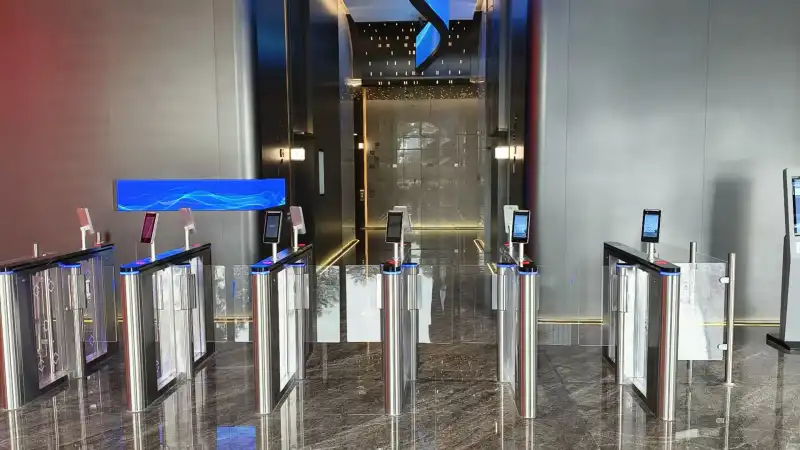
Choose the Right Turnstile for Your Project
👉 Swipe left and right to view full table
| Project Requirement | Recommended Turnstile |
|---|---|
| Lowest-cost pedestrian control | Tripod turnstile |
| Premium office or corporate lobby | Speed gate |
| Wheelchair or wide-lane access | Swing barrier gate |
| High-security unmanned entrance | Full-height turnstile |
| High-volume controlled entrance | Flap barrier or speed gate |
| Construction site attendance control | Tripod or full-height turnstile |
| Stadium or ticketed venue | Tripod or full-height turnstile |
| School or factory entrance | Tripod, swing or flap barrier |
| Outdoor perimeter security | Outdoor tripod or full-height turnstile |
1. What Is a Turnstile Gate?
A turnstile is a gate that lets one person through at a time — and only when the access system says yes.
It works like a regular door, but the arms don’t move until the system gives the go-ahead. Each person has to be authorized first. The gate works with RFID cards, QR codes, fingerprint or face readers, ticketing systems, push buttons, or a third-party access controller.
Where you'll see them
Turnstiles show up in just about any place that needs to control who walks in and out:
- Office buildings
- Factories and industrial parks
- Schools and universities
- Construction sites
- Stadiums and sports venues
- Railway, metro stations, and airports
- Government facilities
- Residential communities
- Tourist attractions
- Data centers
- Warehouses and logistics centers
2. How Does a Turnstile Gate Work?
Every turnstile system is built around the same four parts.
Barrier mechanism
The physical part that stops people — or lets them through. Depending on the model, that’s rotating tripod arms, swinging glass panels, retractable flaps, or a full-height rotating cage.
Turnstile controller
The brain of the system. It takes the opening signal, drives the motor, and handles timing, direction, and alarms.
Identification device
The part that decides who’s allowed in. Common options:
- RFID card reader
- QR-code or barcode scanner
- Fingerprint reader
- Face-recognition terminal
- Ticket scanner
- Mobile credential reader
- Push button
- Remote control
- Visitor-management system
Passage detection system
Motorized turnstiles use infrared sensors to track each person through the lane — whether they entered, exited, turned around, stayed inside, or tried to tailgate someone through.
Here’s the normal sequence, in plain terms:
- The user presents a valid credential.
- The access controller checks it.
- The controller tells the turnstile to open.
- The barrier unlocks and opens.
- The user walks through.
- Sensors (or the mechanical rotation) confirm the passage.
- The barrier locks again.
The exact sequence changes a bit depending on the turnstile, the controller, and your safety setup — but this is the core flow in every system.
3. Quick Turnstile Selection Table
| Model | Core Strengths | Main Drawbacks | Ideal Places |
|---|---|---|---|
| Tripod Turnstile | Low cost, compact, reliable, easy maintenance | No wheelchair access, easy to climb over | Factory, construction site, school, stadium |
| Swing Barrier Gate | Wide lane, wheelchair and luggage passage, modern look | Needs larger installation space | Office, hospital, residential and accessible entrances |
| Flap Barrier Gate | Fast opening, compact lane, high traffic capacity | Narrow passage, sensitive to dust and water | Metro station, office, library and indoor public facilities |
| Speed Gate | Premium appearance, quiet operation, anti-tailgating detection and fast passage | Higher price and precise installation required | High-end office, bank, airport and data center |
| Full-Height Turnstile | High security, anti-climb design and suitability for unmanned outdoor entrances | Large footprint and higher transportation and installation costs | Stadium, industrial perimeter and high-security site |
4. Turnstile Gate Comparison Table
| Type | Security level | Typical passage width | Outdoor option | Wheelchair access | Relative cost |
|---|---|---|---|---|---|
| Tripod turnstile | Medium | Approximately 550 mm | Sheltered outdoor | No | Low |
| Swing barrier | Medium | 600–1200 mm | Optional | Yes | Medium |
| Flap barrier | Medium | 550–600 mm | Optional | Usually no | Medium |
| Speed gate | Medium to high | 550–750 mm | Sheltered outdoor | Wide‑lane configuration available | Medium to high |
| Full‑height turnstile | High | Model dependent | Sheltered outdoor | Special model required | High |
5. How Do I Choose the Right Turnstile Gate?
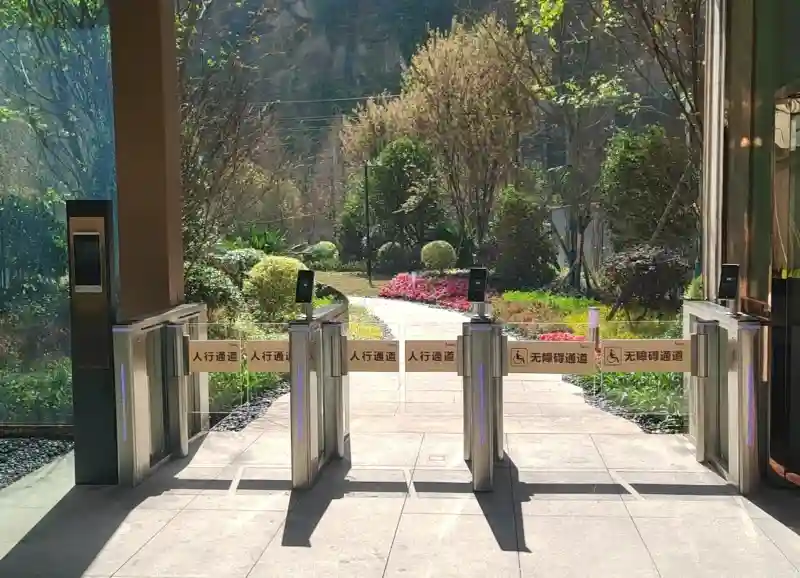
Step 1: Define the application
Decide where the turnstile will be installed.
Factory entrances need durability and attendance integration.
Office lobbies focus on nice appearance and quiet operation.
Unmanned boundaries require full‑height turnstiles.
Step 2: Determine your security level
Clarify if you only need crowd control or strict anti‑intrusion protection.
Basic crowd management: tripod, swing or flap barrier
Office access control: swing barrier or speed gate
Anti‑climbing security: full‑height turnstile
Staffed entrance: waist‑height turnstiles work well
Unmanned entrance: choose full‑height or high‑security models
Turnstiles work with cameras, fences and access software to achieve complete security.
Step 3: Calculate pedestrian flow
The number of lanes depends on total users, peak traffic, waiting time, passing direction, recognition speed and visitor/delivery needs.
Formula: Required lanes = Peak users ÷ Clearing time ÷ Practical throughput per lane
Real passing capacity is lower than theoretical data. Face recognition, QR scanning and security checks will slow traffic.
Step 4: Confirm passage width
Standard lanes fit regular staff. Prepare at least one wide lane for wheelchairs, strollers, luggage, trolleys, large equipment and emergency exits. Check local accessibility rules before finalizing sizes.
Step 5: Confirm identification methods
Select authorized access modes: RFID card, QR code, barcode, fingerprint, face recognition, ticket, mobile app, third‑party controller or visitor management system.
Check signal types: dry‑contact, RS485, TCP/IP, Wiegand or API for system integration.
Step 6: Evaluate installation environment
Indoor / outdoor, with or without shelter, temperature, humidity, coastal salt spray, dust and rainfall, floor condition, power and network supply.
These factors decide cabinet material, protection grade, sealing, heating, cooling and drainage design.
6.Can a Turnstile Integrate With an Existing Access Control System?
Many customers have contacted us asking if we can integrate our equipment into their systems.
Our common systems include:
- RFID access control
- Face recognition
- Fingerprint identification
- QR-code access
- Ticketing systems
- Visitor-management systems
- Attendance systems
Before confirming the order with the engineer, please pay attention to the following points:
1. The reader or controller model
2. Signal type
3. Communication protocol
4. Direction-control requirements
5. Feedback signal requirements
6. Whether the reader will be installed by the manufacturer or locally
7. Whether software integration is required
7. Can Turnstile Gates Be Installed Outdoors?
Yes, but the product must be configured for the actual environment.
- Tripod turnstile: Supports sheltered or fully‑exposed outdoor installation (select outdoor‑rated units).
- Swing barrier: Outdoor‑ready as an option; a canopy is recommended for open‑air sites.
- Flap barrier: Standard units are indoor‑only; special waterproof models are needed for outdoor use.
- Speed gate: For indoor or covered outdoor locations without standing water. Not for fully exposed rainy areas.
- Full‑height turnstile: Well‑suited for outdoor perimeter applications, sheltered or open‑air.
8. Maintenance & Installation Recommendations
Installation
Two things matter at install time: the floor and the cables.
The floor. Level concrete, no shortcuts. On an uneven slab the cabinets sit crooked, and the sensors misalign down the road.
The cabling. Plan two conduits from day one: one for AC power (110V/220V), one for low-voltage data (CAT6 for network and access control). High voltage and data never share a conduit — that’s signal interference waiting to happen.
Maintenance
Three habits, three frequencies. Put them on the schedule and forget about it:
- Clean the sensors — monthly. On swing, flap, and speed gates, dust on the IR sensors causes false alarms or stops the gate closing. One wipe a month avoids both.
- Grease the mechanism — every six months. Tripod and full-height turnstiles have real moving weight. Grease the rotation mechanism twice a year.
- Tighten the anchors — annually. Vibration loosens floor bolts over time. Check and re-tighten once a year, or the gate starts to rock.
Only use lubricants and replacement parts recommended for the selected model. Applying unsuitable lubricant to sensors, belts or electronic components can cause damage.
Outdoor and high-traffic installations should be inspected more frequently than low-traffic indoor systems. Installation and maintenance must follow the instructions for the selected model because the mechanism, sensor layout and electrical configuration may differ.
Need a Customized Turnstile Gate Solution?
9.What Are the Most Common Turnstile Buying Mistakes?
Selecting only by the lowest price
A lower quotation may use a lighter cabinet, simpler mechanism, fewer sensors or a different motor. Compare the complete configuration rather than the product name alone.
Ignoring peak pedestrian flow
A project may have enough lanes for average daily use but still experience queues during shift changes or event entry.
Forgetting wheelchair access
At least one wide passage may be required for wheelchairs, deliveries or emergency use.
Using an indoor model outdoors
Rain, condensation, dust, direct sunlight and temperature changes can reduce product life if the turnstile is not properly configured.
Failing to confirm emergency behavior
Power‑failure and fire‑alarm operation should be defined before production, especially for high‑security and public‑access projects.
Assuming all systems are compatible
Confirm signal type, wiring and protocol before shipping. Software integration should never be assumed without technical verification.
Ignoring installation dimensions
The product may fit the available width while leaving insufficient passage or maintenance space.
Focusing only on opening speed
The complete user experience includes identification time, reaction time, pedestrian behavior and barrier movement—not just the motor’s opening cycle.
Not providing a floor plan
Even a simple marked drawing can help the manufacturer identify lane‑width, direction and installation problems before production.
10. Frequently Asked Questions
Can a turnstile operate in both directions?
Yes. Many turnstiles can be configured for bidirectional passage. Each direction can be controlled independently or set as free passage, controlled passage or no passage.
Can one lane be used for both entry and exit?
Yes, but shared bidirectional operation may reduce traffic efficiency during peak periods. Separate entry and exit lanes are often better for high‑volume projects.
Can a turnstile prevent tailgating?
Sensor‑based swing, flap and speed gates can detect some abnormal passage behaviors and trigger an alarm. However, the effectiveness depends on the sensor configuration, barrier height, user spacing and system settings. No waist‑height turnstile should be treated as an absolute physical barrier.
Which turnstile is best for a factory?
Tripod turnstiles are commonly selected for cost‑effective staff attendance control. Swing or flap barriers may be used where faster passage or wider access is required. Full‑height turnstiles may be preferable for unmanned perimeter entrances.
Which turnstile is best for an office lobby?
Speed gates and swing barriers are popular because they combine modern appearance, quiet operation and access‑control integration.
Which turnstile is best for a construction site?
Tripod and full‑height turnstiles are common choices. The final selection depends on the required security level, whether the entrance is supervised and whether attendance tracking is required.
Can a turnstile work with face recognition?
Yes. A face‑recognition terminal can authorize entry and send an opening signal to the turnstile. Device dimensions, mounting position, signal type and communication requirements should be confirmed in advance.
Can the logo and cabinet color be customized?
Customization may include logos, colors, glass graphics, reader openings, cabinet dimensions and selected functions. Availability depends on order quantity and product design.
How long does a turnstile last?
Service life depends on mechanism quality, usage frequency, environment, installation accuracy and maintenance. Under specified test conditions, the Zhanjiang speed‑gate mechanism has completed more than 12 million opening and closing cycles. The full‑height mechanism has a specified service life of up to 3 million operating cycles under proper installation, use and maintenance conditions. Final performance should always be confirmed for the exact model and configuration.
What spare parts should be ordered?
Recommended spare parts depend on the project size and local maintenance capability. Common options may include control boards, power supplies, sensors, indicator lights, belts, motors and mechanical components.
What is the lead time?
Lead time depends on model, quantity, customization and production schedule. Standard products may be completed faster than projects requiring custom dimensions, colors, software integration or certification.
Does a turnstile require software?
A turnstile can operate as a physical gate after receiving an opening signal, but credential management, attendance reporting and visitor authorization normally require an access‑control or management platform.
Zhanjiang provides turnstile gates and pedestrian access-control solutions for different security, traffic and installation requirements. Available product categories include tripod turnstiles, swing barriers, flap barriers, speed gates and full-height turnstiles.
Our team can help buyers compare configurations, plan lane dimensions and confirm access-control integration before production.
If you need turnstile gate solutions, installation drawings or free professional technical guidance for factory and large engineering projects, check our [Turnstile Gate ] or contact us via WhatsApp:+8618927792680
Get a Turnstile Recommendation for Your Project
Not sure which turnstile is suitable?
Send us the following information:
– Application
– Installation country
– Indoor or outdoor environment
– Number of lanes
– Passage-width requirement
– Access-control method
– Estimated quantity
– Floor plan or site photo
- +86 189 2779 2680
- +86 189 2779 2680
- +86 189 2779 2680
- zhanjianggatemfr@gmail.com